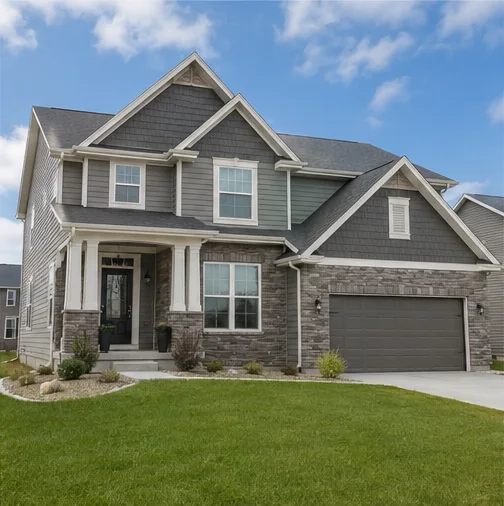
walkout basement home
A walkout basement is one of the most popular layouts in Savage, and for good reason. The city sits on rolling ground that steps down toward the Minne
A walkout basement is one of the most popular layouts in Savage, and for good reason. The city sits on rolling ground that steps down toward the Minnesota River bluffs, so builders working the subdivisions that filled in from the 1990s through the 2010s used those natural slopes to put daylight and full walkout doors on the lower level. The result is a finished lower level that lives like real living space instead of a dark basement. But a walkout home is also a different inspection than a standard buried-foundation house. One wall of your foundation is fully exposed to weather, water has to be routed around a structure that sits partway into a hillside, and the grading that protects you can be undone by a single poorly placed downspout. This page covers what we focus on when we inspect a walkout basement home in Savage, why the local soil, slope, and radon picture matters here, and exactly what we watch for so you know what you are buying.
Why a walkout foundation behaves differently in Savage
On a typical basement, all four foundation walls are surrounded by backfill that holds them and helps shed water. A walkout is asymmetric: the uphill side is buried deep, the downhill side is fully above grade with a door and often large windows, and the two transition walls go from buried to exposed as the grade falls away. That geometry concentrates water and soil pressure where the slope changes. In Savage, where many neighborhoods step down toward the Minnesota River and the Credit River corridor, those slopes are real and sometimes steep. We read the whole site, not just the walls, looking at how the lot drains, where the high side sends runoff, and whether the exposed wall and its transition corners show the stair-step or diagonal cracking that points to uneven soil movement rather than ordinary curing shrinkage.
Grading and drainage on the hillside
Grading is the single most important thing protecting a walkout, and it is also the thing most likely to be wrong on a resale home after years of landscaping, settling, and added patios or decks. The soil should fall away from the buried uphill wall so surface water never collects against it, and the area outside the walkout door and patio should drain to daylight, not pool against the slab. We check that downspouts on the high side carry water well past the foundation instead of dumping it where it can run straight back down toward the lower-level door. On newer Savage builds we frequently see backfill that has settled into a reverse slope toward the house, buried or crushed downspout extensions, and patios poured tight to the wall that trap water. None of these are dramatic on a sunny day, but they are exactly what shows up as a wet lower level after a hard Minnesota spring melt or summer downpour.
Sump pumps, drain tile, and keeping the lower level dry
Almost every walkout in this area relies on a working drainage system to stay dry: perimeter drain tile feeding a sump basin, a sump pump, and a discharge line that gets the water away from the house. Because the lower level is finished living space, a failure here is expensive, so we treat this system as critical. We confirm there is a sump pump, test that it runs, look for a battery backup or note its absence, and trace the discharge line to make sure it terminates well downhill and not in a spot that recirculates water back to the foundation. We check the basin for signs of frequent high water and look at finished walls, baseboards, and flooring near the exposed wall for staining, efflorescence, or past patching that hints at water that already got in. On the slope-heavy lots common in Savage, a discharge line that freezes or dead-ends too close to the house is a recurring problem worth catching before closing.
Radon and the lower level you actually live in
Scott County sits in a part of Minnesota with elevated radon potential, and the Minnesota Department of Health reports that a large share of homes statewide test above the action level. That matters more in a walkout because the lower level is finished, occupied space rather than a utility basement, so people spend real time on the floor with the most direct contact with soil gas. A walkout still has buried foundation walls and a slab in contact with the ground, which are the pathways radon uses, so the daylight door does not make a home immune. We will point out whether a radon mitigation system is already present and appears to be operating, and we always recommend a radon measurement test for any Savage walkout regardless of how new or how bright the lower level looks. Radon is invisible and odorless, and testing is the only way to know.
Newer-build flashing, window wells, and the exposed wall
Many Savage walkouts are newer homes, which is good news for systems and energy but does not make them defect-free. The defects we find on these homes cluster around water management details that were rushed during construction. On the exposed foundation wall and at the walkout door, we look at flashing, the threshold and door pan, caulk joints, and how the siding or stone veneer terminates above grade so water is not wicking behind it. Large lower-level windows and any window wells on the buried sides get checked for proper wells, drainage, and covers, because a clogged or undersized window well is a direct path for water into a finished room. We also look at deck and patio attachments over the walkout, ledger flashing, and the spots where the deck posts and stairs meet the graded slope, since these are common newer-construction weak points around here.
What we watch for
- Negative or settled grading that slopes back toward the buried uphill wall after years of landscaping
- Downspouts and discharge lines that release water too close to the foundation or back down the slope
- Stair-step or diagonal cracks at the transition corners where the foundation goes from buried to exposed
- Sump pump function, basin water marks, and whether a battery backup is present or missing
- Staining, efflorescence, soft baseboards, or fresh patching on finished lower-level walls near the exposed side
- Flashing, door pan, and caulking at the walkout door where the exposed wall meets siding or stone veneer
- Window wells on the buried sides for proper depth, drainage, and covers that keep water out
- Deck and patio ledger flashing and attachments over the walkout, a common newer-build leak point
- Whether a radon mitigation system is installed and operating, plus a recommendation to test the finished lower level
Buying or selling a walkout basement home in Savage? Get a clear, plain-English inspection that focuses on the grading, drainage, and exposed-wall details that actually matter on a hillside home, with your full report delivered within 24 hours. Call us at (952) 583-8608 or build your free instant quote online in about a minute. We will tell you straight what we find and what it means for the home.
Get Your Instant Quote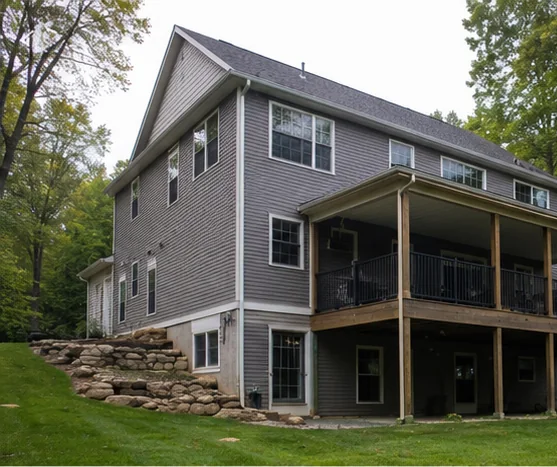
See your price in under a minute.
Build your quote and book your Savage-area inspection online — or call (952) 583-8608.